Watch 101
Quartz vs Automatic: Which Movement Should You Buy?
 Michael Chen·8 min read
An automatic watch runs on a coiled spring that your wrist winds for you. Here is the path the energy takes through the movement, what the numbers in a spec sheet mean, and how to live with one.
Prices checked October 9, 2026Compared across brandsHow we choose
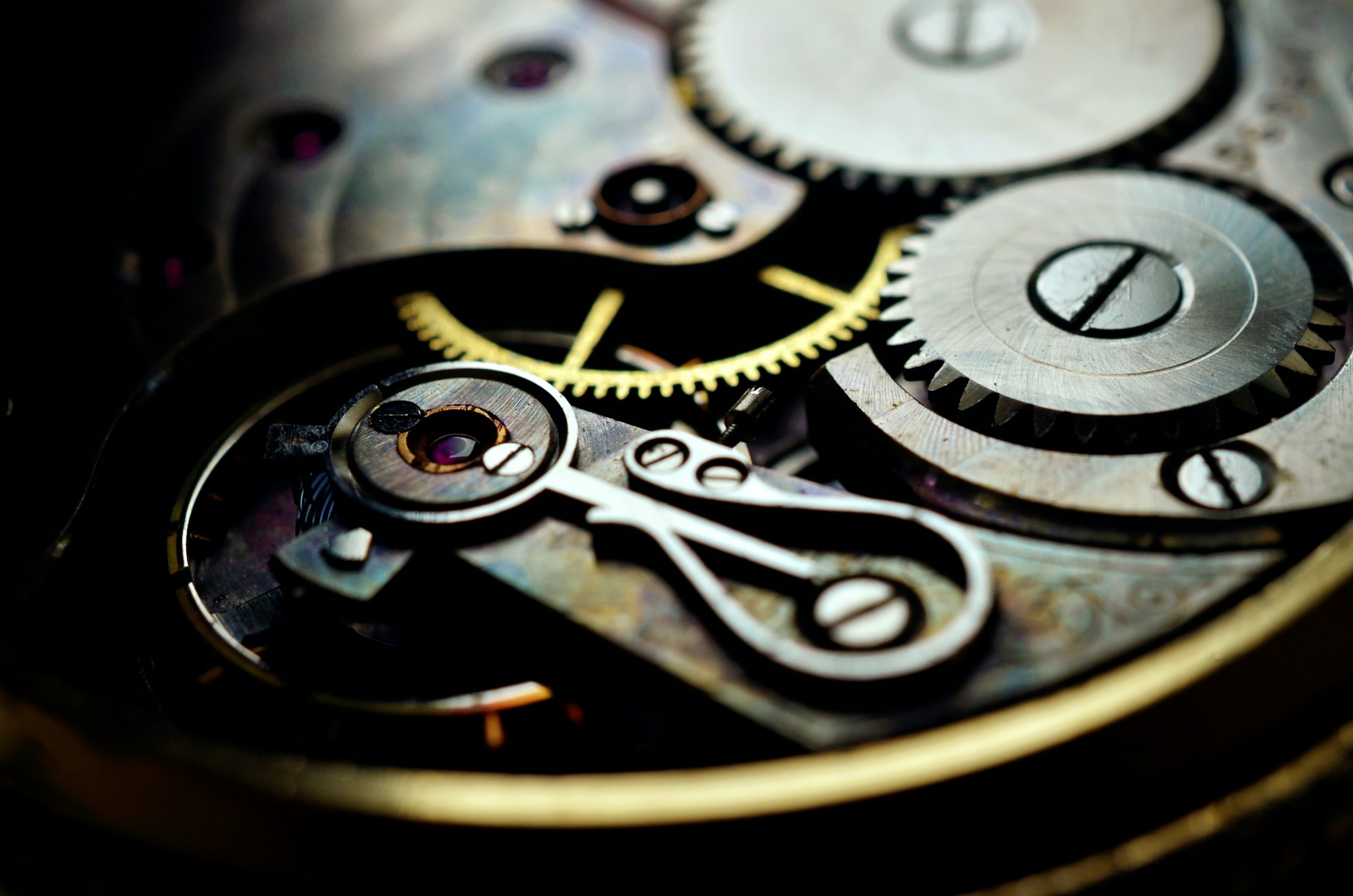
An automatic watch has no battery. Its power comes from a coiled spring, and the spring is wound by the movement of your arm through the day. Inside, a few hundred parts turn that stored energy into the steady, sweeping motion of the seconds hand. It is a nineteenth century solution to a problem quartz solved in the 1970s, which is exactly why people still love it: it is a small machine you can wear, and it works without electronics of any kind.
Here is the path the energy takes, from your wrist to the hands.
Turn an automatic over, and if it has a display back you will see a half moon of metal on a central pivot. That is the rotor. It is weighted at the edge, so every movement of your wrist swings it round. Through a set of reduction gears and a ratchet, those swings wind the mainspring a little tighter. Most modern rotors wind in both directions; some only in one.
The mainspring is a long ribbon of alloy coiled inside a drum called the barrel. As it is wound, it stores energy, and as it slowly uncoils it turns the barrel. When the spring is fully wound, a slipping bridle lets it slide inside the barrel rather than break, which is why you cannot overwind an automatic by wearing it.
The barrel drives a train of wheels, each turning faster than the one before. One of them turns once an hour and carries the minute hand, another turns once a minute and carries the seconds. Left alone, this train would spin out in a few seconds and empty the spring. Something has to hold it back.
The escapement does that. A toothed escape wheel at the end of the train is locked and released by a small pallet fork that rocks from side to side. Each rock lets the wheel move one tooth forward, which produces the ticking sound, and gives the fork a tiny push in return.
The pallet fork is rocked by the balance wheel, a weighted ring attached to a hairspring that swings back and forth at a fixed rate. That rate is the heart of the watch. A common figure on modern movements is 21,600 or 28,800 beats an hour, six or eight beats a second, which is why a mechanical seconds hand sweeps in small steps instead of jumping once a second like quartz.
Price tracker · prices checked October 9, 2026
What one watch has cost over time, listed and per watch while the store ran its offer.
| Spec | What it means | Typical on affordable automatics |
|---|---|---|
| Power reserve | How long the watch runs, fully wound, once taken off | Around 40 hours; some newer movements much longer |
| Beat rate | How fast the balance swings | 21,600 or 28,800 beats an hour |
| Accuracy | How many seconds a day it may gain or lose | Within tens of seconds a day |
| Jewels | Synthetic rubies used as low friction bearings | Around 21 to 26 |
| Hand winding | Whether the crown can wind the spring | Most, but not all |
| Hacking | Whether the seconds hand stops when you set the time | Common, not universal |
General figures; each movement's own specification is the reference.
Two of these deserve a comment. Accuracy at this level is modest: a quartz watch might drift a few seconds a month, an affordable automatic a few seconds or more a day, and that is normal rather than a fault. And more jewels does not mean a better watch; past the number needed at the main pivots, extras add little.
Among the established brands, the Seiko 5 Sports ($350) and the Citizen Tsuyosa ($495) are good examples of a sound, widely serviced automatic, and the Tissot PRX Powermatic 80 40mm at $850 is named for its power reserve of up to 80 hours, roughly twice the usual.
An automatic worn every day stays wound. One that spends the weekend in a drawer will usually have stopped by Monday. The routine for getting it going again:
Keep it away from strong magnets, such as speakers and laptop clasps, since a magnetized hairspring makes a watch run fast. If it suddenly gains minutes a day, that is the usual cause, and a watch shop can demagnetize it in seconds.
The automatic is not the more accurate or the more practical choice. It is the more interesting one. If you like the idea of a watch that runs on a spring and a swinging wheel, and do not mind setting it after a weekend off the wrist, it rewards you every time you look at the seconds hand. If you want a watch that is always right and never needs attention, buy quartz. Our quartz vs automatic comparison sets out the trade offs in full.
Automatics with an open dial make the case best, because you can watch the balance at work. The Lucky Fours Skeleton at $99.99 shows its movement through a blue openwork dial, and the Spine at $149.99 does the same in an octagonal case. More open dial and closed dial options are compared in automatic watches under $200 and explained in what a skeleton watch is.
WatchesUnder is owned by BlackRobin Capital Inc.
Until the power reserve runs out, typically around 40 hours on affordable movements and longer on some newer ones. Then it stops and needs winding and setting again.
Not through normal wear. A slipping bridle lets the mainspring slip once it is fully wound. Winding by the crown is also safe; you simply feel no further resistance or hear the winding continue without effect.
Only if you own several automatics, want them ready to wear and wear each one rarely. For one or two watches, a few turns of the crown before you put it on does the same job.
Makers usually suggest every five to ten years, depending on the movement. An affordable automatic is often replaced rather than serviced, since a service can cost more than the watch.
Michael Chen covers automatic watches, watch brands and Watch 101 for WatchesUnder: how movements work, how to size and care for a watch, and how the affordable brands compare. Prices in his guides are checked against each brand's own website.
Watch 101
Michael Chen·8 min read
Watch 101
Michael Chen·4 min read
Price Guides
Michael Chen·5 min read
Watch 101
Michael Chen·4 min read
We use cookies and similar technology to see which guides are read. When you arrive from an ad, we also pass the ad's click identifier to the store you visit from our links. You can accept or reject this, and change your choice any time under Cookie settings. Privacy policy
