
Watch 101
How to Set a Day Date Watch
 Michael Chen·4 min read
Two small windows on the dial hide a surprisingly clever mechanism. We explain how the day and date advance, how to set them without damage, and which affordable day date watches are worth buying.
Prices checked October 9, 2026Compared across brandsHow we choose
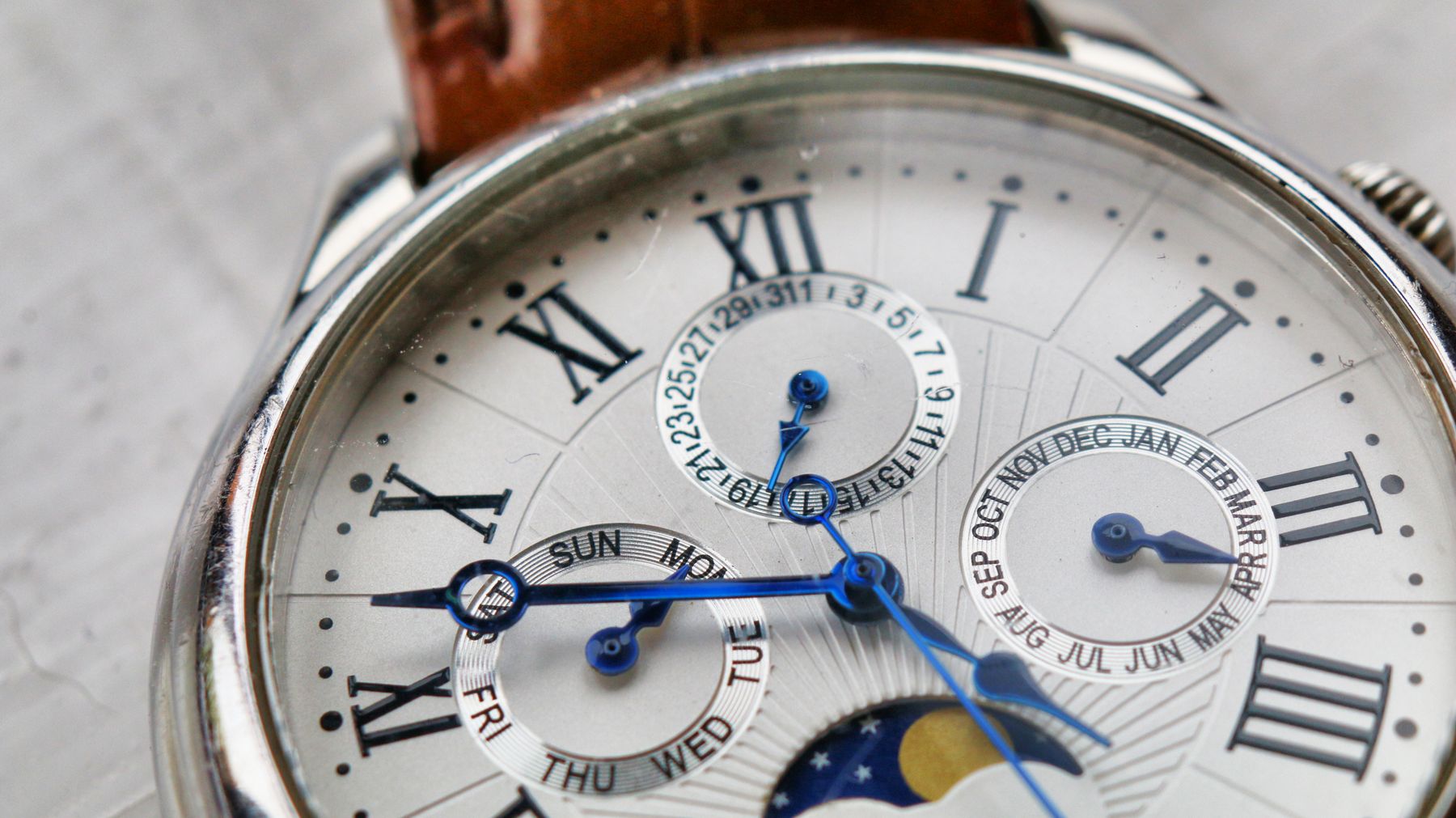
A day date watch shows more than the time: a window, usually at 12 o'clock, with the day of the week, and another, usually at 3, with the date. It is one of the most useful complications in watchmaking, and one of the most taken for granted. Few owners ever think about what turns those numbers over at midnight, until the day they set the date at the wrong hour and it jams.
This guide explains the mechanism behind the windows, how to set it safely, and the affordable day date watches worth considering. If it is mainly the look of the classic day date dress sports watch you are after, our separate guide to day date style watches under $150 focuses on design; this one is about how the complication works.
WatchesUnder is owned by BlackRobin Capital Inc.
Watch Index · prices checked October 9, 2026
Every watch this guide mentions, ranked by Value Score or by what one watch costs today with each store's current offer counted.
Under the dial, the hour wheel drives a second wheel that turns once every 24 hours. That wheel carries a small finger. Once a day, as midnight approaches, the finger meets the teeth of a large, thin ring printed with the numbers 1 to 31, the date wheel, and pushes it forward one position. A spring loaded jumper then clicks it neatly into place so the new number sits centered in the window.
The day works the same way with a smaller star shaped wheel of seven points, or 14 on movements that print the days in two languages, one for each point. A second finger on the same 24 hour wheel pushes it on one step each night. Two wheels, two fingers, one daily nudge: that is the whole complication, and it is why a day date adds only a little to the cost of a movement.
On most affordable movements, quartz and automatic alike, the finger pushes the wheel gradually. Over an hour or so around midnight, the number creeps sideways until the jumper takes over, and if you glance at the watch at 11:45 p.m. you may see half of one date and half of the next. More expensive movements use an instant changeover, where a spring is loaded during the evening and released at exactly midnight, so the date snaps. It is a refinement, not a necessity.
Nobody wants to wind through 24 hours of hands to move the date forward one day, so most watches have a quick set: pull the crown to its middle position and turn it one way to advance the date, the other way to advance the day. It works by moving the wheels directly, bypassing the finger.
That is where the risk comes in. In the hours before midnight, the finger is already engaged with the date wheel's teeth. Force the wheel forward with the quick set while the finger is in the way and something has to give. Most manuals warn against using the quick set roughly between 9 p.m. and 3 a.m.; the exact hours depend on the movement. The safe habit is simple: before setting the date, move the hands to about 6 o'clock, set the day and date, then set the time. Our step by step guide, how to set a day date watch, covers the crown positions in detail.
A standard day date counts to 31 in every month. After a 30 day month, and twice after February, you need to advance it by hand. Watches that know the length of each month exist: an annual calendar needs correcting once a year, and a perpetual calendar, which also knows leap years, runs for decades. They are among the most complex complications made and sit far above this guide's budget.
The day at 12 and date at 3 layout is most closely associated with one famous steel and gold dress sports watch, and the Lucky Fours Santos is the most complete affordable take on it: fluted bezel, five link bracelet, and both windows in their traditional places. It is the watch in this guide where the complication is part of the design rather than an addition to it. It costs $129.99 and comes in an unusually wide 18 colorways, from red and green dials to gold tone and two tone versions.
WatchesUnder is owned by BlackRobin Capital Inc.
Not everyone wants the day at 12. The Fortuno and the all black Brone put the day and date side by side in a single window near 3 o'clock, the more common layout on everyday watches. The Fortuno has a teal sunray dial on an integrated style bracelet and suits someone who wants the complication with a clean dial. The Brone wraps it in a black integrated case and bracelet. Both cost $79.99.
The Seiko 5 Sports at $350 is the classic mechanical day date: an automatic movement with a day date window at 3, a rotating bezel and a see through caseback, so you can watch the rotor that powers it. It is the one to choose if you want to understand the mechanism by owning it. The Timex Q Continental 39mm at $179 is a quartz day and date watch on a steel bracelet, and the Timex Easy Reader Day Date 35mm at $73 is the simplest and least expensive day date we know of from a major brand, on a leather strap.
| Watch | Price* | Layout | Movement |
|---|---|---|---|
| Timex Easy Reader Day Date 35mm | $73 | Day and date | See Timex listing |
| Lucky Fours Fortuno | $79.99 | Day and date together near 3 | Quartz |
| Lucky Fours Brone | $79.99 | Day and date together near 3 | Quartz |
| Lucky Fours Santos | $129.99 | Day at 12, date at 3 | Quartz |
| Timex Q Continental 39mm | $179 | Day and date | Quartz |
| Seiko 5 Sports | $350 | Day and date at 3 | Automatic |
*as listed on each brand's US website, October 2026
WatchesUnder is owned by BlackRobin Capital Inc.
If the complication itself interests you, buy the Seiko and watch the rotor through the back; our explainer on how automatic watches work pairs well with it. If you want the most recognizable day date design for the least money, the Santos is the answer, and with buy one, get one free on mix and match, a second Santos in another dial color costs nothing extra. For the names of every part mentioned above, see watch anatomy.
WatchesUnder is owned by BlackRobin Capital Inc.
During those hours many movements are already engaging the date wheel for the midnight change. Forcing the quick set then can bend or break the teeth. Move the hands to 6 o'clock first, then set the date. The exact window varies, so check your manual.
No. A standard day date counts to 31 every month, so after a 30 day month or February you advance the date by hand. Only annual and perpetual calendars handle that automatically.
Advance the hands until the day and date change. That moment is midnight, so from there, set the time forward to the correct hour of the morning or keep going another 12 hours for the evening. Our guide on how to set a day date watch walks through it.
Many affordable movements use a gradual changeover, where the wheel is pushed across over an hour or two around midnight. Instant changeovers, which snap at exactly 12, need an extra spring and are more common on dearer movements.
Michael Chen covers automatic watches, watch brands and Watch 101 for WatchesUnder: how movements work, how to size and care for a watch, and how the affordable brands compare. Prices in his guides are checked against each brand's own website.
Watch 101
Michael Chen·4 min read

Look Expensive
 Daniel Reyes·4 min read
Watch 101
Michael Chen·6 min read

Watch 101
Michael Chen·4 min read
We use cookies and similar technology to see which guides are read. When you arrive from an ad, we also pass the ad's click identifier to the store you visit from our links. You can accept or reject this, and change your choice any time under Cookie settings. Privacy policy
