Watch 101
Watch Anatomy: Every Part of a Watch, Explained
 Michael Chen·6 min read
Every term you are likely to meet on a spec sheet, in a review or at a watch counter, defined in a sentence or two. Jump to a letter, or link straight to any term.

Watch talk borrows from French, Swiss German, engineering and a century of marketing, so the vocabulary can be harder than the watches. This glossary covers the terms that matter to a buyer, written in plain English and kept short. Where a term has a fuller explanation elsewhere on the site, we link to it. For how these parts fit together physically, see watch anatomy.
Acrylic crystal. A plastic watch crystal, also called plexiglass. Light, shatter resistant and warm looking, it scratches easily but can be buffed clean with a polishing paste. Common on vintage and vintage inspired watches.
Analog. A display that shows time with hands moving over a dial, as opposed to digits.
Analog digital. A watch combining hands with a small digital display, often used for a second time zone, alarms or a stopwatch.
Applied index. An hour marker made as a separate small piece of metal and fixed to the dial, rather than printed. It adds depth and catches light.
Automatic. A mechanical movement that winds itself through a rotor turned by the motion of your wrist. Also called self winding. See quartz vs automatic.
Balance wheel. The weighted wheel in a mechanical movement that swings back and forth at a steady rate, regulated by the hairspring. It is the timekeeping heart of the watch.
Barrel. The drum that houses the mainspring.
Baton hands. Simple straight, narrow hands. A clean, classic shape found on dress and minimalist watches.
Bead blasted. A matte, slightly grainy finish made by blasting metal with fine glass beads. Hides scratches well and suits tool watches.
Beat rate. How many times per hour a mechanical balance ticks, quoted in vibrations per hour. Higher beat rates give a smoother sweep of the seconds hand. Affordable automatics commonly beat at 21,600 or 28,800.
Bezel. The ring around the crystal. It may be fixed and decorative, or rotate to carry a timing, time zone or tachymeter scale.
Bracelet. A metal band made of links. Three link and five link designs are the most common; a mesh bracelet is woven from fine wire.
Brushed finish. Fine parallel lines rubbed into metal to give a satin look. Often alternated with polished surfaces on the same case.
Caliber. The model of a movement, identified by a name or number. Two watches from different brands can share the same caliber.
Caseback. The back of the case. Solid backs are often engraved; display backs have a window onto the movement.
Chapter ring. A ring around the edge of the dial printed with minute or hour markings, sometimes angled like a short wall between dial and crystal.
Chronograph. A watch with a stopwatch function, operated by pushers and read on subdials. See what is a chronograph.
Chronometer. A watch whose movement has been certified as meeting a defined accuracy standard by an official testing body. Not to be confused with a chronograph, and not a guarantee unless the certificate exists.
Clasp. The fastening on a bracelet. A folding clasp hinges shut and usually locks with a safety catch.
Complication. Any function beyond hours, minutes and seconds: a date, a chronograph, a moonphase, a second time zone.
Crown. The knob on the side of the case used to set the time and date and, on mechanical watches, to wind the mainspring.
Crown guards. Raised shoulders on the case that protect the crown from knocks.
Crystal. The transparent cover over the dial. The common types are acrylic, mineral glass and sapphire, in rising order of hardness and price.
Cushion case. A case shape between a square and a circle, with rounded sides like a pillow.
Cyclops. A small magnifying lens on the crystal above the date window, making the date easier to read.
Dauphine hands. Tapered, faceted hands shaped like long triangles, split down the middle so each half catches light differently. A dressy choice.
Day date. A watch that shows both the day of the week and the date, usually in windows at 12 or 3 o'clock. See day date watches.
Deployant clasp. A folding clasp used on a leather strap, so the strap is not bent through a buckle each time you put it on.
Dial. The face of the watch, carrying the markers, logo and any windows or subdials.
Display caseback. A caseback with a transparent window showing the movement. Also called an exhibition caseback.
Dive bezel. A rotating bezel with a minute scale, usually turning in one direction only, used to time an interval by lining up its marker with the minute hand. See what is a dive bezel.
End link. The first link of a bracelet, shaped to meet the case. Solid end links are machined from one piece; folded ones are bent sheet metal.
Escapement. The mechanism that releases a mechanical watch's energy in small, regular steps. Its pallet fork and escape wheel produce the ticking sound.
Field watch. A simple, legible watch descended from military issue pieces: clear numerals, a plain case and usually a fabric or leather strap.
Fluted bezel. A bezel cut with fine vertical ridges that reflect light. Originally functional, now a dressy signature.
Flyback. A chronograph that can be reset and restarted with a single press of the lower pusher while running, useful for timing consecutive intervals.
Gasket. A rubber or synthetic ring that seals the caseback, crown and crystal against moisture and dust. Gaskets age and should be replaced at service.
GMT. A watch with an extra hand that circles the dial once every 24 hours, showing a second time zone, often read against a 24 hour bezel. See what is a GMT watch.
Guilloche. An engraved, repeating pattern on a dial, traditionally cut by hand on a rose engine. Stamped versions imitate the effect.
Hacking seconds. A feature that stops the seconds hand when the crown is pulled out, so you can set the watch to the exact second.
Hairspring. The fine coiled spring attached to the balance wheel that makes it oscillate at a steady rate.
Hand wound. A mechanical watch without a rotor, wound by turning the crown. Also called manual winding.
Horology. The study and craft of measuring time and making clocks and watches.
Index. An hour marker on the dial. Plural indices. May be printed, applied, or a numeral.
Integrated bracelet. A bracelet designed to flow directly out of the case without separate lugs, so case and band read as one shape.
Ion plating. A process that bonds a thin colored layer to steel for black, gold tone or rose gold tone finishes. Related to PVD.
Jewels. Synthetic rubies used as bearings for pivots in a mechanical movement, reducing friction and wear. A higher jewel count does not by itself mean a better watch.
Lug. One of the four projections on a case that hold the strap or bracelet.
Lug to lug. The distance from the tip of the top lugs to the tip of the bottom lugs, which decides whether a watch overhangs your wrist. See watch size by wrist.
Lug width. The gap between the lugs, which sets the width of strap that fits. Common sizes are 18, 20 and 22 millimeters.
Lume. Luminous material on hands and markers that absorbs light and glows in the dark.
Mainspring. The coiled spring that powers a mechanical watch.
Mechanical. A movement powered by a spring and regulated by a balance wheel, with no battery. Includes both automatic and hand wound watches.
Mechaquartz. A quartz movement fitted with a mechanical chronograph module, giving crisp mechanical style pushers and resets.
Micro adjustment. Small holes or a sliding extension in a clasp for fine tuning bracelet length without removing links.
Microbrand. A small watch brand selling in limited numbers, usually online. See microbrand watches explained.
Mineral crystal. Hardened glass used for watch crystals. Harder than acrylic, softer than sapphire, and standard on many affordable watches.
Minute track. The scale of minute marks around the edge of a dial. A railroad minute track looks like a section of train track.
Moonphase. A complication that shows the current phase of the moon through a curved window on the dial.
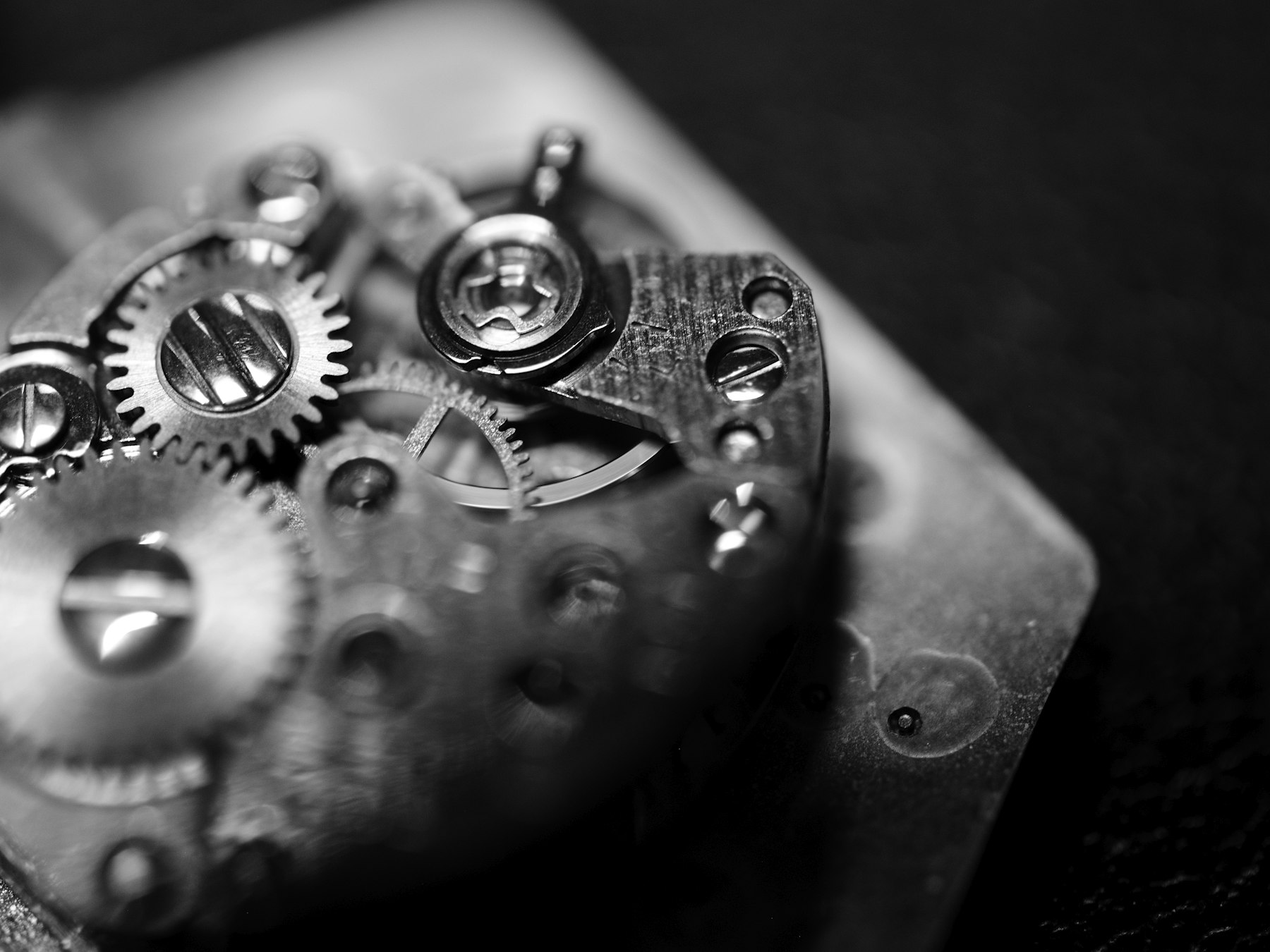
Movement. The mechanism inside the case that keeps time and drives the hands. Also called the caliber.
NATO strap. A single piece fabric strap that threads under the watch between the spring bars, so the watch stays on the wrist even if one bar fails.
Open heart. A dial with a single cutout showing the balance wheel at work, a smaller version of the skeleton idea.
Panda dial. A white or silver dial with black subdials, so it resembles a panda's face. A reverse panda is the opposite: a black dial with white subdials. See panda dial chronographs.
Perpetual calendar. A complication that tracks the date, accounting for month lengths and leap years, without manual correction.
Pilot watch. A watch designed for legibility in the cockpit: large numerals, a big crown and often a triangle marker at 12. Some carry a slide rule bezel.
Power reserve. How long a fully wound mechanical watch runs before stopping, commonly around 40 hours on affordable automatics.
Pushers. Buttons on the side of the case that operate a chronograph or other function.
PVD. Physical vapor deposition, a process that bonds a thin, durable coating to metal, used for black and gold tone finishes.
Quartz. A battery powered movement regulated by a vibrating quartz crystal. Accurate, inexpensive and low maintenance.
Quickset date. A crown position that changes the date directly, rather than by turning the hands through 24 hours.
Retrograde. A hand that travels across an arc and then jumps back to its start, rather than circling the dial.
Rotor. The half circle weight on an automatic movement that swings with your wrist and winds the mainspring.
Sapphire crystal. A crystal made of synthetic corundum. Very scratch resistant, it is standard on more expensive watches.
Screw down crown. A crown that threads onto a tube in the case to seal it. It must be unscrewed before you can set the watch.
Skeleton. A watch whose dial, and often movement plates, are cut away to show the mechanism. Some quartz watches imitate the look. See what is a skeleton watch.
Slide rule bezel. A rotating logarithmic scale used for calculations such as fuel, speed and unit conversions, typical of pilot watches.
Solar. A quartz watch charged by light through the dial, storing energy in a rechargeable cell.
Spring bar. A small sprung rod that holds a strap or bracelet between the lugs.
Sterile dial. A dial with no brand name or text.
Subdial. A small dial within the main dial, used for chronograph counters, running seconds or other functions.
Sunray dial. A dial brushed with fine lines radiating from the center, so light sweeps across it as you move. Also called sunburst.
Sweep seconds. A seconds hand that moves in small, rapid steps that look continuous, typical of mechanical watches.
Swiss made. A legal designation requiring a defined share of a watch's value and its movement to come from Switzerland, with final assembly and inspection there. See Japanese vs Swiss watches.
Sword hands. Hands shaped like broad blades, tapering to a point, often filled with lume.
Tachymeter. A scale on the bezel or dial edge that converts elapsed time over a known distance into speed. Used with a chronograph.
Tonneau. A barrel shaped case, wider in the middle with curved sides.
Tool watch. A watch designed for a practical task, such as diving, flying or field work, and built to be legible and robust.
Tourbillon. A rotating carriage that holds the escapement and balance, turning them continuously to average out the effect of gravity in different positions. Complex and costly; models sold under the name at low prices are often styled to look like one rather than containing one.
Two tone. A watch combining two metal colors, usually steel with gold tone, often on alternating bracelet links.
Unidirectional bezel. A rotating bezel that turns one way only, so an accidental knock can only shorten, never lengthen, a timed interval.
Vintage inspired. A new watch styled after older designs, often with domed crystals, cream lume and smaller cases.
Water resistance. A rating of how well a case keeps water out under test conditions, given in meters, bar or atmospheres. The figure is a pressure under laboratory conditions, not a safe diving depth; the lowest ratings cover splashes only. Seals age, so the rating applies to a well maintained watch.
Winding. Tensioning the mainspring of a mechanical watch, by turning the crown or by the rotor on an automatic.
World time. A complication showing the time in many cities at once, usually via a rotating 24 hour ring and a ring of city names.
Missing a term you came across? Most of what appears on a spec sheet is covered here or in our explainers on how automatic watches work and choosing a watch size.
The distance from the tip of the top lugs to the tip of the bottom lugs. It is the real length of the watch on your wrist and the best single predictor of whether it will overhang.
Any function beyond hours, minutes and seconds, such as a date, a chronograph, a second time zone or a moonphase.
The model of movement inside the watch. Brands give each movement a caliber number, much as car makers name their engines.
A chronograph is a watch with a stopwatch function. A chronometer is a watch whose accuracy has been certified to a defined standard. A watch can be either, both or neither.
Michael Chen covers automatic watches, watch brands and Watch 101 for WatchesUnder: how movements work, how to size and care for a watch, and how the affordable brands compare. Prices in his guides are checked against each brand's own website.
Watch 101
Michael Chen·6 min read
Watch 101
Michael Chen·8 min read

Watch 101
Michael Chen·4 min read
Watch 101
Michael Chen·4 min read
We use cookies and similar technology to see which guides are read. When you arrive from an ad, we also pass the ad's click identifier to the store you visit from our links. You can accept or reject this, and change your choice any time under Cookie settings. Privacy policy